30 November 2011

Final Portfolio Guidelines

Please read and follow the the below guidelines for your Final Portfolios carefully, as deviations from this formatting could cause you to lose points. If you have any questions regarding what is expected of you, or how your material should be assembled, please do not hesitate to email me:

1) All material should be place in a pocketed folder; no binders, plastic sleeves, or loose pages. Make sure your name is clearly identifiable on the front of the folder.

2) All five, individual poems, their critical introductions, and their subsequent revision hisitories should be stapled in separate packets. Each packet should be order in the following manner: a) a one-paragraph introduction that outlines not just what or how you revised throughout the various drafts, but, most importantly, why you made particular revisions (While I don't expect you to quote Kinzie, directly, your decisions should be predicated upon concepts and ideas we've read in The Poet's Guide to Poetry. Just justifications should be clearly stated.); b) the final draft of your poem; c) at least two intermediate drafts; d) your prose meditation that you used to initiate the writing process.

3) One of your five poems must be the poem we worked on in your conference. For your conference poem, you must included, in addition to the material stated in the above guideline, any notes you or I wrote during our conference session. These notes should be stapled with the other material at the bottom of the packet.

4) One of your five poems must be the poem we work-shopped in class. For your work-shop poem, you must included, in addition to the material stated in the above guideline, the comments made by your peers and myself about your poems. These comments should be stapled with the other material at the bottom of the packet; if, for some reason, your peer did not write any comments on your poem (or wrote very few comments that happened not to be relevant), do not include these in the packet.

5) Final Portfolios will be due at the beginning of class on Monday, December 5th. Those students whose poems will be work-shopped during our final class session will need to drop their Final Portfolios in my campus mailbox by 2:00PM on Wednesday, December 7th.

21 November 2011

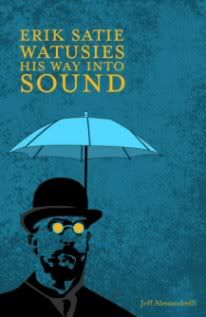
Poet Q & A: Jeff Alessandrelli on Erik Satie Watusies His Way Into Sound

1) Tell us about when you first became interested in poetry. Who were your first poetic influences? When did you begin writing poetry? What do you think poetry does or can do for us today and does this differ from your earliest conceptions of what poetry is/does? etc.

I first became interested in poetry in high school—I really liked the Beat poets, particularly Gary Snyder. Allen Ginsberg I was half-scared of, but him too. I started writing—both poetry and fiction—during my sophomore year of high school, but not seriously; just as a lark. The first creative writing course I took was as a junior in high school from Tom Meschery, former center for the San Francisco (now Golden State) Warriors—Wilt Chamberlain once scored a 100 points on him (there were other defenders as well but Meschery was the primary one). He was a good teacher of creative writing generally and fostered my interest in poetry particularly—I remember on the first day we had to write a variation on W.C. Williams’ famous poem “so much depends/ upon/ a red wheel/ barrow/ glazed with rain/ water/ beside the white/ chickens” and mine was “so much/ depends upon/ the first sound/ of laughter/ shared/ between/ new friends.” Along with one or two other examples, he chose to read mine out loud to the class, which probably stoked my poetry writing ego a bit. As for what I believe poetry can do today vs. when I first started writing, I’d again refer to W.C. Williams, this time with regards to a statement he made to fellow poet Louis Zukofsky near the end of his life: “To write badly is an offence to the state since the government can never be more than the government of words.” That sounds melodramatic, and it is, but I do think it’s true. More so than just about anything else in this world, language matters, and poems are written out of particles and schisms of language. Sticks and stones may break my bones but words can never hurt me is bullshit—a smack to the face might hurt more in the moment, but the words leading up to it will in all likelihood last in your head longer. Your face will probably heal.

2) Give us some background on the creation, development, and gestation of Erik Satie Watusies... How does this collection differ from your previous collections or current projects? etc.

Erik Satie Watusies His Way Into Sound was originally conceived in a poetry workshop class like the one y’all are in right now. The final obligation for the course was to put together a chapbook of poems, one that had some type of overriding thematic concern. Going into the project I didn’t really have a subject; I had a bunch of disparate poems all written over the course of 8 or 9 weeks, all with different subject matters/ line lengths/ syntactical notions, etc. But I needed to come up with something. Actually, that’s a lie—due to the fact that since my first year in grad school I’ve consistently read a lot of serial/ longer poems (John Berryman’s The Dream Songs and Homage To Mistress Bradstreet, Wallace Stevens’ “The Auroras of Autumn,” Anne Carson’s Short Talks, a hefty amount of Jack Spicer’s work, Mathias Svalina’s serial-poem-chapbook Creation Myth, and a few months before the workshop I started working on Erik Satie Watusies His Way Into Sound) I wanted to come up with something—not for the class as much as myself really. Throughout the workshop I’d been listening to a lot of instrumental/ vaguely electronic music, particularly the group Boards of Canada (check them out, especially their albums Music Has the Right To Children and The Campfire Headphase), as well as the solo artist Brian Eno. Somehow this got me thinking about Erik Satie—before I moved to Lincoln I lived in Portland, Oregon, and the first year I lived there I’d discovered Satie’s “Gymnopédies” and “Gnossienne” pieces and listened to a mix cd of them and a few other Satie compositions every morning for about 8 months straight. I really liked that Satie cd because I didn’t really have to listen it; for me it was (and is) background noise in the best way possible. Soothing. While in Portland one night my friend Dylan had told me about how weird a dude Satie was, specifically that he tried to push his girlfriend out a window and only ate foods colored white. To make a long story short I listened to that same Satie cd for a couple of days while thinking about a longer project type deal, still liked what I heard/was inspired, checked out some books on Satie/by Satie and started working on the book. It came together as a final collection about a year or so later.

3) What is your favorite or most memorable poem from the collection we're reading? What about the poem, its process, or its inspiration makes it particularly remarkable for you?

My favorite poem is the “Erik Satie Watusies His Way Into Sound” prose poem on page 16. I like history—I minored in it as an undergrad—and I think the part about Napoleon/Caesar/Alexander the Great/Hercules is interesting. I can’t remember where I read it, but I’m 95% sure it’s true. I’ve also been to a lot of all-age punk shows and have seen my fair share of wilting mohawks.

4) What was the most difficult poem for you to write? Why? How did you overcome or think through these challenges?

They weren’t difficult to actually write, but all of the “sheet music” poems were difficult to transfer/ transpose onto the individual pieces of sheet music, especially due to the fact that I am horrible with computers. In the end they came together, and I think that for the most part they look good in the book, but they were by far the most difficult part of rounding together the manuscript. Your teacher helped me out a lot with them, and I am eternally grateful to him for that help.

5) What, to your mind, is the overriding concern of Erik Saite Watusies...? How do specific craft or poetic elements contribute to, intensify, or complicate to this concern?

This is probably a cop-out, but I’m not sure there is a specific overriding concern. Contextually I’d say it’s important to have heard maybe one or two Satie pieces of music before starting the book, but I’ve talked to a couple people who read the entire collection without listening to any of Satie’s music and according to them it didn’t make a whole lot of difference—they treated him as more of a character rather than a historical figure. Which is fine, I suppose, although I think listening to at least a couple pieces of Satie’s music—specifically the “Gymnopédies” and “Gnossienne” compositions perhaps—might make reading the book more rewarding. Very early on in the publishing process there was talk about including a Satie cd with the book, but that idea got shelved quickly because of conflicting rights to the music/ feasibility issues/ etc. I don’t know—we live in a rapid-fire, 24-7 world, and I realize that writing a book of poetry loosely based around the life/work of a French avant-garde composer that’s been dead for over 70 years might seem kind of silly to a lot of people. But I think Satie’s music stands up, and he was in the epicenter of what has since became known as “Modernism,” at least in terms of Western Culture—he worked on plays with Picasso and Jean Cocteau, hung out at Gertrude Stein’s place on occasion, and along with Claude Debussy and Maurice Ravel is known as being one of the first “Modern” composers because of some of his harmonic/tonal innovations. He was an interesting guy. I suppose, then, the overriding concern of the book for me is making both Satie’s music and personality interesting on some level to the reader, and I hope I achieved that to a certain degree at least.

16 November 2011

UPDATE: 11.16.11

Class, as always, you will need to write a craft-based review of this week's poetry collection, which is Emily Carr's Directions for Flying: 36 Fits: A Young Wife's Almanac, quoting both the text itself and Kinzie's A Poet's Guide to Poetry when appropriate. Below are your individual poem assignments:
Miranada: "Sparrow"
Kelly: "Tiara"
Matthew Carter: "Home"
Matthew Chanlynn: "Birdbath"
Kimberly: "Piano"
Katlin: "Sprawl"
Samual: "Tongue"
Alyssa: "Lyric"
David: "O"
Taylor: "Child"
Jennifer: "Skyscraper"
Jessica: "Hinge"
Ashley: "Selvedge"
Rachel: "Mayfly"
Hailey: "Yolk"
Lindsay: "Limbo"
Hanna: "Bus"
Luke: "Groove"
Joseph: "Zoetrope"
Reviews will need to be turned in at the break during Monday's class session. Also, please be actively working on revising the five poems you've selected for your final portfolio. I'm expecting at least four substantial revisions for all five poems, as well as a paragraph or so that documents your revision history, etc. for each poem. These documents will not only outline what and how you've revised, but, most importantly, why you've revised.

Finally, Jessica, Ashley, and Hailey should email me poems for next week's work-shop by tomorrow night so I can send them out to the class.

08 November 2011

Richard Greenfield's Tracer

Richard Greenfield, unfortunately, wasn't able to answer the questions I presented to him, but there are a variety of online sources that may help you when engaging his work. Check out the following reviews, etc. that address some poetic concerns found within Tracer:


Finally, below are two videos of Greenfield reading some poems from Tracer during a book tour. He prefaces these selections with some explanatory statements that might be helpful:


UPDATE: 11.08.11

For next class period, please read Richard Greenfield's Tracer. As I mentioned in class, this will be the most difficult (and longest) book we'll read this semester, so please begin early (i.e. now). After reading Greenfield's collection, please write a one-page, single-spaced review of the book. As a reminder, focus on an elements (or elements) in Kinzie, such line breaks, syntax, diction, tropes, or rhetoric/voice, quoting her when necessary, then use specific examples from the poem you're assigned to demonstrate how they function. Finally, explain those elements's overall effect on that poem. Hard-copies of your reviews will be due in class on Monday. Below is the list of poem assignments:
Miranada: "Guideline"
Kelly: "Two Reports"
Matthew Carter: "Last of the Butterflies"
Matthew Chanlynn: "Actuary"
Kimberly: "Artificial"
Katlin: "Annals"
Samual: "Tacit Rainbow"
Alyssa: "Sale"
David: "Was It / It Was"
Taylor: "The Future"
Jennifer: "The Sign"
Jessica: "Eris"
Ashley: "The Session"
Rachel: "Sublimity Will Not Be the End"
Hailey: "Rapier/Ravine"
Lindsay: "Speaking For"
Hanna: "Bastion"
Luke: "Maverick"
Joseph: "Newness"
Also, we will meet this Saturday evening for the Clean Part Reading Series. Below is the notice from the Clean Part blog. More information can be found here:
On Saturday, November 12, please join us at 7 pm to hear Lily Brown and Elisa Gabbert read for The Clean Part. Free and open to the public, drop by Drift Station Gallery, located at 1746 N Street in downtown Lincoln (corner of 18th St.), to hear some wonderful poetry and win some November-ish raffle prizes! See you soon!
As with the previous event, you will need to write a one-page, single-spaced response to the event, focusing on a particular image, phrase, or poem that you found compelling, unique, or troubling and discuss its effect on the poem, reading, or yourself. Do not provide, merely, a narrative of the evening. Reading responses will be due, via email, on Wednesday, November 16th.

Also, David, Taylor, and Jennifer, please email me poems to be work-shopped by tomorrow evening so I can get them to your classmates as earlier as possible. As a reminder to all, make sure you've commented on your peer's poems thoroughly and before class, focusing on the concepts we've covered in Kinzie.

Finally, everyone should be actively working on selecting the five poems you'll want to include into your portfolio and revising them extensively.

06 November 2011

UPDATE: 11.06.11

As a reminder (I mentioned this during class and it's also on the syllabus), you are to have the chapter "Rhetoric and Speech" and "Rhythm as Combination" in A Poet's Guide to Poetry (pages 187-214) read for class and ready to discuss.

Also, we will be work-shopping poems by Kim and Samual in tomorrow's class, both of which you've previously received and should have already commented on. An email has been sent to you with Alie's poem; please comment on it. We're going to try hard to get all three work-shopped in tomorrow's class session.

An additional note about workshops: Please, when discussing your peer's poems, focus on line breaks and half-meaning, syntactical structures and the manner in which they are dispersed across lines, the use of diction, the implementation of tropes, and the rhetoric of the speaker of the poem. Moreover, when offering you peers feedback, speak of/about the poems using the language and terms we've read in Kinzie. Not only will this demonstrate to me that you're reading and comprehending the texts, but it will provide us with a common language and clearly identifiable ways in which to assess the general merits of the poems we work-shop.

25 October 2011

UPDATE: 10.25.11

Since we did not get a chance to work-shop Kelly's poem in class yesterday, we will begin with her poem during the second-half of our next class. In addition to her poem, I will need new poems from Kim, Kaitlin, and Samual emailed to me by 10PM Thursday night so that I can get them to the rest of the class by Friday morning at the latest. Again, please make sure you write your feedback and revisions directly on the hard-copies and before class.

Furthermore, for next class session, please read Chris McCreary's Undone: A Fakebook. Afterword, please write a 1-page, single-spaced review of the collection. If any of you need a refresher on the general parameters of these reviews, you can find them in the previous Limón post.

Below is the list of poem assignments. Please focus on the poem you are assigned; toward the end of the review, if you would like to, you can expand outward and connect your particular poem to the collection at-large, drawing comparisons, resonances, and like-minded issues, etc. between them:
Miranada: "Yesterday's Song"
Kelly: "Solitary Man"
Matthew Carter: "Two-bit Manchild"
Matthew Chanlynn: "Albatross"
Kimberly: "Botched Chupacabra"
Katlin: "Disinvited"
Samual: "Ethan Frome Goes"
Alyssa: "Half-Imagined Juju"
David: "Kultured Lycans"
Taylor: "Martyrs Need Onanism"
Jennifer: "Paris"
Jessica: "Quiet"
Ashley: "Rue"
Rachel: "Screaming Trees
Hailey: "Ultraviolence"
Lindsay: "We Were X"
Hanna: "Yoda"
Luke: "Zenith"
Joseph: "Pretty Monsters"
If, by chance, there is a poem you found to overwhelmingly compelling to you, and no one else is writing on it, email me and we can schedule a switch. Obviously, there are many more poems in this collection than there are students, so this shouldn't be a problem.

Poet Q & A: Chris McCreary on Undone: A Fakebook

1) Tell us about when you first became interested in poetry. Who were your first poetic influences? When did you begin writing poetry? What do you think poetry does or can do for us today and does this differ from your earliest conceptions of what poetry is/does? etc.

I don’t recall liking much poetry in high school beyond Walt Whitman and some poems by Ralph Waldo Emerson that sat alongside his essays (which also made a significant impact on me) in our textbook. I think I had a passing interest in the Romantics, but it was more the idea of them than their actual poems. I discovered, as many have before and since, Jack Kerouac through his novel On The Road, which led me to poets like Allen Ginsberg and Michael McClure by the time I left for college. When I discovered Charles Bukowski in the middle of college, I took a detour for a few years that led to writing really narrative, cynical poems that I loved at the time – but I look back on them now and think, So what? Is that all there is? In a sense, I was being rigorous, learning to pare down my lines, but in retrospect I was relying on lazy storytelling more than anything else at that time.

As the years have gone on, I’ve stayed interested in shorter lyrics, for the most part, coming late to Emily Dickinson but making up for lost time and even preferring her to Whitman these days. Poets like George Oppen, Rae Armantrout, Norma Cole, Michael Palmer, and Robert Creeley have convinced me that every word counts. They’re almost all off-kilter & odd.

As far as what poetry can do... for me, it’s an exercise in mental exploration, both in terms of the pliability of words and sounds and in terms of what gets dredged up, psychologically, during even the most oblique approaches to writing. Grand proclamations about the role of poetry in the world have never interested me very much, but I will say that the poetry community, particularly Philly’s, has been a cornerstone of my sense of self for almost 20 years. Many of my favorite “younger” poets - and as I approach 40, I use that term increasingly loosely – live here in Philly: Frank Sherlock, Kirsten Kaschock, Jenn McCreary, too many others to list here. I’ve been reading Frank and Jenn’s work since college, and to’ve seen their work evolve over a decade and a half is extraordinary.

2) Give us some background on the creation, development, and gestation of Undone. How does this collection differ from your previous collections or current projects? etc.

Undone came about over a period of four years or so. At that point, I’d written two previous collections (The Effacements and Dismembers). My newer poems felt tighter, as they came together, and fairly early on I started to lift material from the two previous books to incorporate into new poems in an effort to “get it right” this time around, which primarily meant editing down overly wordy passages in an effort to distill them and weave them into newer work. Also, I decided on a couple of frames to block out major sections, “The Diamond Sutra” and “Fiend Folio.” Originally, the piece known as “Black Star” was much longer – maybe 20 pages – and incorporated much of what became “The Diamond Sutra.” I was stuck with it, though, feeling like the poem drifted too much and never had much at all to say. Once I conceived of the “Sutra” approach, though, much of the material fell into place. For kicks, I was knocking Neil Diamond song titles (and, at times, lyrics) up against other pop culture sources and some truly bastardized tenets of Buddhism to see what I’d come up with, and through that the Sutras as a sequence came into being. “Fiend Folio,” once I decided on the alphabetic sequence, began to take care of itself, with some of the last pieces (“Martyrs Need Onamism,” for instance) being plotted out specifically to fit the gaps in between earlier pieces such as “Albatross” and “Rue.”

3) What is your favorite or most memorable poem from the collection we're reading? What about the poem, its process, or its inspiration makes it particularly remarkable for you?

“The Black Book” was probably the most satisfying to write, so in that sense it’s my favorite. That one in particular incorporates lots of old material in a way that finally felt right. Beyond that, though, I was pleased with how I managed to sustain (I hope) the poem over so many pages, and I liked the creepy, vaguely cartoonish tone that it strikes. I particularly enjoy the disconnect between the sing-song sound of some of the passages and what’s actually being described within them, which is often quite dark. It’s a blast to read aloud, too – sometimes people laugh, and sometimes I think they’re not sure if bits of it are supposed to be funny or not...

4) What was the most difficult poem for you to write? Why? How did you overcome or think through these challenges?

“Pretty Monsters” was probably the most difficult to write. It’s the piece in the book most explicitly about my own children and the closest I think I come to sentimentality in the book. I kept coming back to the piece over the course of months, reworking and tweaking it, trying to make the narrative more disorienting and therefore, with any luck, intriguing instead of it just being a narrative about my family.

I recognize that what I’m saying has no bearing on a workshop situation at all, where writing has to be produced quite quickly, but the most important thing for me has become giving pieces time – weeks or months to sit – before I come back to finish them. I can bang up against problems in a poem repeatedly as I obsess over it, but then if I let it rest for a while, the solution is almost always obvious as soon as I sit back down to it after an extended breather.

5) What, to your mind, is the overriding concern of Undone? How do specific craft or poetic elements contribute to, intensify, or complicate to this concern?

These are really the first poems that I wrote after becoming a parent and also shifting from teaching college to teaching high school, and the presence of younger people (and generational conflict) is probably evident. “The Great American Songbook” can seem to some people like a toss-off, but it’s the most direct statement in the book, really, about aging, desire, and language itself, and they provide something of an echo chamber for much of what goes on elsewhere in the collection.

12 October 2011

UPDATE: 10.12.11

As a reminder, we do not have class on October 17th due to Fall Break. Enjoy the time off, but you will be expected to have several assignments completed for our next session on October 24th; they are as follows:

1) Read chapter 5 in Kinzie, titled "Trope and Thought," which can be found on pages 142-186.

2) Write a new poem for class. As always, first compose a 250 to 300 word prose meditation, read the assigned Kinzie, then revise your prose meditation based upon concepts covered in our reading.

3) The following students must email me their new poems by October 19th, and I will, in turn, email them to the entire class for work-shopping purposes: Miranda, Kelly, and both Matthews.

4) Everyone must provide hand-written comments (directly on a hard-copy of the student poems) for all four students. If you are one of the students providing us your poems, you must comment on the other three poems. This comments must be done before our next class and be as rigorous and critical as the comments I provided on your poems during our conferences. Please be prepared to share our thoughts about these poems in a instructive and helpful manner.

04 October 2011

UPDATE: 10.04.11

For next Monday's class session, you will need to bring a few documents with you. First, you will need to have a hard-copy of your second-draft of a new poem written "in the style of Tina Brown Celona." As such, after you write you 250 to 300 word prose meditation, ask yourself: what aesthetic, as well as thematic, concerns do I find in The Real Moon of Poetry, and how can I apply those techniques and ideas to the prose that I've written in my first-draft? Pay special attention to the manner in which she a) handles different types or styles of diction (i.e. high or low, concrete or abstract, monosyllabic or polysyllabic), b) how her use of diction alters the poems rhythm, c) how she develops half-meanings through her line breaks and d) the variable syntax of her sentences as she disperses them throughout the poem (and over a given line or stanza). Likewise, what types of images does Celona use and in what manner? In addition to the hard-copy you bring to class, make sure you email me a version by 10PM on Sunday night.

You will also need to bring a hard-copy of your review on The Real Moon of Poetry to Monday's class session. Remember, think through the poems and their relationship to the concepts we've covered in Kinzie. In order to support your claims, be sure to quote both the poem(s) from The Real Moon of Poetry and A Poet's Guide to Poetry when necessary. If you need a refresher on more specific parameters, reread the Limón post.

Below is the list of poem assignments. Please focus on the poem you are assigned; toward the end of the review, if you would like to, you can expand outward and connect your particular poem to the collection at-large, drawing comparisons, resonances, and like-minded issues, etc. between them:
Miranada: "Sentences"
Kelly: "Poet Sex"
Matthew Carter: "Fantastic Heart"
Matthew Chanlynn: "Event"
Kimberly: "Notes"
Katlin: "In My Beginning"
Samual: "The Adolescent"
Alyssa: "Dakota"
David: "Narrative"
Taylor: "A Song for the Moon"
Jennifer: "Jade Rabbit"
Jessica: "Five Difficulties"
Ashley: "Our Youth"
Rachel: "Spectacular Emotion"
Hailey: "The Office in Wartime"
Lindsay: "The Big Day"
Hanna: "Hiroshima"
Luke: "Dream"
Joseph: "Kosovo"
If, by chance, there is a poem you found to overwhelmingly compelling to you, and no one else is writing on it, email me and we can schedule a switch. Obviously, there are many more poems in this collection than there are students, so this shouldn't be a problem.

Finally, it appears that Tina Brown Celona will be with us during our next class-session, so please, compose 3 questions that specifically address craft and technique elements within the collection, referencing particular passages when applicable. Bring hard-copies to class, but make sure to email your questions by 10PM on Thursday, October 6th.

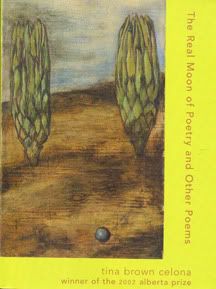
Poet Q & A: Tina Brown Celona on The Real Moon of Poetry

1) Tell us about when you first became interested in poetry. Who were your first poetic influences? When did you begin writing poetry? What do you think poetry does or can do for us today and does this differ from your earliest conceptions of what poetry is/does? etc.

It doesn’t make for a good story but I first started writing poems when I was in 9th grade. I had to write a paper on Sylvia Plath for English class.

As an undergraduate I was influenced by Russell Edson, Plath, Frank O’Hara, James Schuyler, Ezra Pound, Joseph Ceravolo, Michael Palmer, Robert Creeley, Frank Stanford, Jack Spicer, Mina Loy, Bernadette Mayer, Ted Berrigan, Keith Waldrop, and the Fluxus and Abstract Expressionist movements in art.

Later I became interested in Louis Zukofsky, Lorine Niedecker, James Tate, Nicanor Parra, Pablo Neruda, and the fiction writers Lydia Davis and David Markson.

Most recently I’ve been influenced by Edwardian fiction, Shelley, Emily Dickinson, and some younger writers, many of whom I know personally to some degree. I think a feeling of connection with a writer is necessary for influence, which is why many writers are influenced and inspired by their contemporaries: Thoreau by Emerson, Fitzgerald by Hemingway, Shelley by Keats, and vice-versa. But it’s possible to feel similarly connected to a poet who has been dead for 200 years just by reading his poems.

2) Give us some background on the creation, development, and gestation of The Real Moon of Poetry and Other Poems. How does this collection differ from your previous collections or current projects? etc.

About 80% of The Real Moon of Poetry was written while I was working on my MFA. I had published a couple of the poems in Epoch, a literary magazine based at Cornell, and a classmate had done a chapbook for me that included what was kind of a breakthrough poem for me, but which I didn’t include in TRMOP. It was called “Not Modern But The Modern World” and it was a breathless and slightly hysterical expression of angst.

My second collection, Snip Snip!, wasn’t as successful as TRMOP because I wrote the poems over a shorter period of time, and with on the one hand a kind of overblown confidence in myself, and on the other bleak depression and insecurity. It was a very egotistical book.

Since completing the coursework for a Ph.D. I feel like I have a more solid understanding of what poetry is, and how it has changed over time. Reading Aristotle and Horace on poetry, and then Alexander Pope and Shelley and Emily Dickinson, gave me a different and fuller understanding of poets and readers of poetry, what people come to poetry for. The relationship of poetry to emotion and imagination, for instance, is something that I think I understand better now than I used to.

3) What is your favorite or most memorable poem from the collection we're reading? What about the poem, its process, or its inspiration makes it particularly remarkable for you?

A poem that stands out for me (and other people, from what they tell me) is “A Poem Without A Camel.” That was designed to be a very accessible poem that worked on the principle of metonymy and metaphor. The camel can be anything you want it to be, but for me it was something pretty specific and also general: any prohibition applied to poetry. So the person writing the poem without a camel was doing what everyone said you couldn’t do, finding out that it wasn’t impossible after all. People have told me the poem is sad. It is both exhilarating to write without a camel, and sad when one wants the camel again and can’t have it. “The Velveteen Rabbit,” a children’s story by Margery Williams about a toy bunny whose boy grows up and forgets him, probably had an influence on this poem.

4) What was the most difficult poem for you to write? Why? How did you overcome or think through these challenges?

For me the difficulty lies not so much in writing poems as in publishing them. So, the poem that was most difficult for me to see in print was probably “Farm” or “Fantastic Heart” or “Poet Sex” or “On Saturday” because they were so deliberately ugly and self-punishing.

To me a poem is either a success or a failure. Poems that are easy to write tend to be successes. Some poems require more preparation and study than others. Fiddling with a poem rarely makes it better. Lopping off lines, stanzas, paragraphs, sentences, and phrases often makes it worse. If you are trying too hard to write a poem, you are probably either tired or uninspired. In that case you should stop writing and do something else until you find something that inspires you, and get some rest. But don’t expect inspiration to fall into your lap. While you are waiting for it you should be filling your head with words, ideas, images, and reacting emotionally to life, and simulacra such as books and movies. Think of this as preparing the ground for a poem, so that when the seed of inspiration falls into the furrow it has an excellent chance of growing into a beautiful flower or majestic tree.

5) What, to your mind, is the overriding concern of The Real Moon of Poetry? How do specific craft or poetic elements contribute to, intensify, or complicate to this concern?

The Real Moon of Poetry is about loving poetry while simultaneously being tormented by one’s desire and need for it. Ugliness and beauty, love and longing, fear and contempt. The white moon of poetry and the black crow that pecks at your entrails. Even more than “what is poetry?” the poems ask “is this poetry?”

I think that the poems are pretty forthright in the way they address these polarities, and metaphysical or existential problems are solved by application to real or imaginary-world situations. Feelings are invested in things and the things (or, more precisely, the words for them) in turn produce feelings. Images or symbols you might call them instead of things, but to me it makes more sense to think of words as objects in the poem’s field. The imagination is affected by things, or images of things, abstractions don’t awaken it. Poetry is different from other types of human inquiry because its form is self-evidently necessary, so that it can never be superseded or transcended by content (its body can never be left behind or forgotten).

03 October 2011

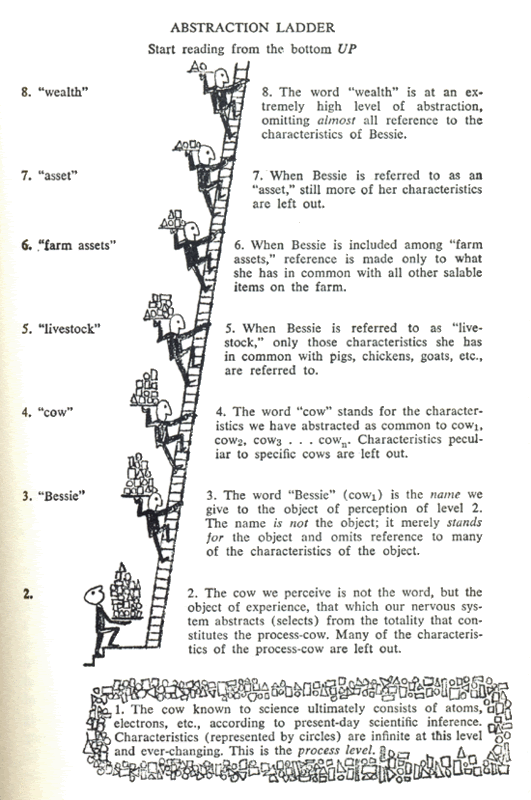
Ladder of Abstraction

The image below visually and linguistically outlines S.I. Hayakawa's Ladder of Abstraction and demonstrates what we mean when we speak of abstract and concrete language; I hope, to some extent, this will further clarify the issue for all of us. To see a larger version, please click the image:

27 September 2011

Conference Schedule

Just as an FYI: the two Saturday conferences listed below are slotted for an hour before the Clean Part Reading Series; so, if you want, you could "knock out two birds with one stone," as the old adage goes. Obviously, I'll probably have to add more times if no one takes the three that occur today (September 28th), but don't count on me adding something "better" than what is currently available, per se:
Wednesday September 28, 1:00PM: CLOSED
Wednesday September 28, 1:30PM: CLOSED
Wednesday September 28, 2:00PM: CLOSED
Thursday, September 29, 2:00PM: Kelly
Thursday, September 29, 2:30PM: Hailey
Thursday, September 29, 3:00PM: Matthew Carter
Friday, September 30, 2:45PM: Kaitlin
Friday, September 30, 3:15PM: Alie
Saturday, October 1, 5:45PM: Samual
Saturday, October 1, 6:15PM: Kim
Sunday, October 2, 12:30PM: CLOSED
Sunday, October 2, 1:00PM: CLOSED
Monday, October 3, 9:00PM: Luke
Wednesday, October 5, 1:00PM: Joey
Wednesday, October 5, 1:30PM: Lindsay
Wednesday, October 5 2:00PM: David
Thursday, October 6, 2:00PM: Ashley
Thursday, October 6, 2:30PM: Hanna
Thursday, October 6, 3:00PM: Miranda
Friday, October 7, 2:00PM: Jessica
Friday, October 7, 2:30PM: Matthew Chanlynn
Friday, October 7, 3:25PM: Jennifer

Sunday, October 9, 12:30PM: Rachel
Sunday, October 9, 1:00PM: Taylor

UPDATE: 09.27.11

This Saturday at 7PM the Clean Part Reading Series, in conjunction with The Drift Station, will host a joint reading by Lisa Fishman and Danielle Pafunda. The Drift Station is located on the Northwest corner of 18th & N; I would suggest showing up a few minutes early so you can sign-in with me, get a good seat, or check out the artwork, etc. Remember, make sure you bring something to jot-down notes with and on. Specifically, you'll want to listen for particular images, lines, phrases, or passages that you find compelling, unique, or noticeable. Based upon these notes, you'll need to compose a 1-page, single-spaced response in Times New Roman, 12-point font with one-inch margins. The response should not be a narrative of the event and your experience, but, instead, should be your thoughts and understandings of the poet's words that you recorded. Responses are due the following Monday, October 3rd in class.

For Monday's class, you will also need to have read pages 111-141 in Kinzie (i.e. Diction and Layers of Meaning), which we will discuss in class.

Finally, you will need to email me a digital copy of the 2nd draft of a new poem by 10PM on Sunday night, as well as bringing a hard-copy of that same poem to class the following day. Make sure, as always, to write your prose meditation first, then read the Kinzie material before revising your prose into verse.

Obviously, you have plenty to do this week for this course, so don't wait until the last minute.

21 September 2011

UPDATE: 09.21.11

For next Monday's class session, you will need to bring a few documents with you. First, you will need to have a hard-copy of your second-draft of a new poem written "in the style of Ada Limón." As such, after you write you 250 to 300 word prose meditation, ask yourself: what aesthetic, as well as thematic, concerns do I find in Sharks in the Rivers, and how can I apply those techniques and ideas to the prose that I've written in my first-draft? Pay special attention to the manner in which she develops half-meanings through her line breaks and the variable syntax of her sentences as she disperses them throughout the poem (and over a given line or stanza). Likewise, what types of images does Limón employ and in what manner? To this extent, be cognizant of her use of metaphor, which occurs rather frequently in her poems. In addition to the hard-copy you bring to class, make sure you email me a version by 10PM on Sunday night.

You will also need to bring a hard-copy of your review on Sharks in the Rivers to Monday's class session. As a reminder, I want you to veer away from interpretive (i.e. literary) readings of these poems and focus more on craft and technique elements. This is not to say that you should never address interpretive modes of writing, but it should always be foregrounded through poetics and/or aesthetics and not be the primary focus of your review. Instead, think through the poems and their relationship to the concepts we've covered in Kinzie. In order to support your claims, be sure to quote both the poem(s) from Sharks in the Rivers and A Poet's Guide to Poetry when necessary. Over and above quoting material, describe how the concepts you address in a particular poem function and to what effect? Finally, as a matter of formatting, make sure of the following:
1) Book titles are in italics. Do not put excerpts from the books in quotation marks (unless the author has already done so).
2) Poem titles and excerpts from both books are in quotation marks.
3) Line breaks from quoted material should be indicated with the virgule [i.e. the forward slash (i.e. /)].
4) Papers are to be 1 single-spaced page typed in 12-point, Times New Roman font with 1-inch margins. Your header should simply be your name on one line, with the book title on the next in the top left-hand corner (e.g. Joshua Ware / Sharks in the River Review).
Below is the list of poem assignments. Please focus on the poem you are assigned; toward the end of the review, if you would like to, you can expand outward and connect your particular poem to the collection at-large, drawing comparisons, resonances, and like-minded issues, etc. between them:
Miranada: "Flood Coming"
Kelly: "Good Enough"
Matthew Carter: "Rescue Animals"
Matthew Chanlynn: "This Practive"
Kimberly: "Body of Rivers"
Katlin: "Overjoyed"
Samual: "The Barer the Bones"
Alyssa: "The New World of Beauty"
David: "Marketing Life for Those of Us Left"
Taylor: "Homesick"
Jennifer: "The Crossing"
Jessica: "The Commute"
Ashley: "The Same Thing"
Rachel: "Drowning in Paradise"
Hailey: "The Weather Reported"
Lindsay: "Sting"
Hanna: "The City of Skin"
Luke: "Big Star"
Joseph: "Fin"
If, by chance, there is a poem you found to overwhelmingly compelling to you, and no one else is writing on it, email me and we can schedule a switch. Obviously, there are many more poems in this collection than there are students, so this shouldn't be a problem.

I would also like you to compose 3 questions that specifically address craft and technique elements within the collection, referencing particular passages when applicable. We will use these questions for discussion purposes in class.

20 September 2011

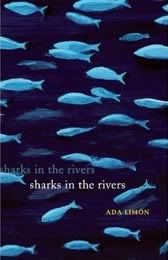
Poet Q & A: Ada Limón on Sharks in the Rivers

Limón, Ada. Sharks in the Rivers. Minneapolis, MN: Milkweed Editions, 2010.

As was the case with Trey Moody's Climate Reply, I asked Ada Limón, author of Sharks in the Rivers, to answer a few questions about the book we will be reading, as well as some questions about poetry and the writing of poetry in general. Below you will find her responses:

1) Tell us about when you first became interested in poetry. Who were your first poetic influences? When did you begin writing poetry? What do you think poetry does or can do for us today and does this differ from your earliest conceptions of what poetry is/does?

I first became interested in poetry when I was a kid, probably 8 or 9. I wrote songs all the time and fell in love with rhymes. Then, of course came many years of bad songs and bad poetry where I had no idea what I was doing, but I wanted very much to be doing something poetic. I began writing in earnest in college. I took three poetry workshops at the University of Washington and suddenly decided to become a poet. I was totally addicted. It was as if someone pointed out to me a trap door to a hidden city that I always suspected was there, but couldn’t quite find my way in. Once I found it, I never wanted to leave. I still don’t.

In the beginning, I thought poetry was a wonderful translation of the world. I had no idea that the power of it was in the mystery is held. When I first became good at “reading” poetry and therefore, “got” the meaning of many more poems, I fell into that familiar trap of solving poems. As if they were puzzles. Now, I find so much more joy in what cannot be figured out, or what can be read many ways. I find so much more delight and power in the mystery.

My first real poetic influences were Elizabeth Bishop, Philip Levine, and Sharon Olds. I read them all in high school and later, studied with both Levine and Olds in graduate school at New York University. It was a real gift to finally get to study with your poetic heroes. I was in awe, and completely over my head. I think that’s a good way to really start to learn the craft.

2) Give us some background on the creation, development, and gestation of Sharks in the Rivers. How does this collection differ from your previous collections or current projects?

Sharks in the Rivers was in the works for about four years before it was released by Milkweed Editions just one year ago. I spent a lot of time making sure this book, and each individual poem, was as solid, and as expansive, as possible. This book was different from the others in the sense that the poems needed to really speak to each other in order for the whole book to work. I wanted to work with repetition in a way that I hadn’t tried before. I wanted to focus on the natural imagery in with juxtaposition the man-made world. With this in mind, I was prepared to repeat many images, such as birds, fish, rivers, water, rocks, sharks, etc. Each poem had to be strong enough to hold up to the big bully of repeated lines, and the book as whole needed to feel like it had one big, powerful river was running through it, moving it forward.

3) What is your favorite or most memorable poem from the collection we're reading? What about the poem, its process, or its inspiration makes it particularly remarkable for you?

True confession: all the poems in the book are my favorite. I just need different ones at different times. I feel tremendously close to it. It was both a very personal process and a very alarmingly expansive process. The poem that feels like it’s the anchor, or crux, of the book is, “Fifteen Balls of Feathers.” I feel like this poem was unstoppable. And I mean that literally. I wrote it in one sitting, albeit, it was a 9 hour stint. Still, the words came, the images came, the story came, all of it in one frenzied and yet calculated wave. It was a remarkable personal event. I could barely move. It was the most marvelous torture I have ever experienced.

4) What was the most difficult poem for you to write? Why? How did you overcome or think through these challenges?

The most difficult poem for me was probably, “The Crossing,” and that has a lot to do with the fact that my step-mom was dying when I wrote it. It was a very honest poem about a very intimate moment between the two of us. She really did ask if I thought she would come back. She had only a few years left to live. It was hard to imagine that sort of long death. The kind you can attempt to prepare for, the wondering, the hoping, the questioning about what is next. The only way I could get through it was to focus on the rhythm and the structure of the poem, and in that way, the poem held me in its arms and made me keep going.

5) What, to your mind, is the overriding concern of Sharks in the Rivers? How do specific craft or poetic elements contribute to, intensify, or complicate to this concern?

The singular goal of all my work is to help people, and myself, constantly recommit to the world. To stay in it. To be in it. To rejoice in all its weird pain and weird happiness. I wanted Sharks in the Rivers to keep doing that, to keep pushing the idea of being open to the flood of everything that’s alive around us and in us. The river, the animals, all those images that repeat are trying to hammer in the idea of what we take in, all that is coming at us, how brilliant and how messy it all is. How, how we’re in the river together, it’s going to keep going, we’re just supposed to ride it as long as we can without letting go. No drowning allowed. You can go under, but you must come back. All our want and all our desire and all our agony are part of it, so we swallow it like water.

I never wanted to complicate the theme, I wanted to clarify it always, but sometimes the strange images that came to me had to be written just as they came, the demanded to be written as their true selves. Sharks are demanding. Fish are demanding. Birds are demanding. They want to be written right. Like love, and death, and all the big ticket stuff in between.

16 September 2011

UPDATE: 09.16.11

In addition to re-writing the poems we worked on during our last class session, you are to write a 250 to 300 word prose meditation that will function as the first-draft of another poem. As I mentioned, after writing your prose, you are to read the Kinzie chapter titled "Syntax and Whole Meaning" before turning that prose into verse. To wit, you should focus on the manner in which line and syntax produce a tension between one another within a poem when employed effectively; or stated differently:
the line of verse cannot be discussed, let alone produced, without attention to the form of speech it contains. In fact, syntax—or the way the sentence is organized—is one necessary defining principle of the poetic line. All lines of verse either coincide with the phrase, clause, or sentence, or diverge from the phrase clause, or sentence, thus splitting the phrasal units and causing tension between line and syntax. (75)
Obviously, to understand how to produce tension (via coincidence or divergence), you'll need to comprehend what Kinzie means when she refers to the terms clause, phrase, and sentence (and each subsequent permutation or type of a sentence she writes about in the chapter).

Of course, a few cautionary words about the relation between line and syntax need to be re-stated. First, the "thresholds of invention in poetry are closely bound up with thematic suggestion"; in this sense, "form should follow theme" (87), at least while you're initially exploring the art of poetry. Second, remember that none of the techniques that Kinzie mentions in "Syntax and Whole Meaning" function or operate in one specific manner within all contexts. As she states late in the chapter: "None of these effects is univocal or unchanging" (107). Finally, when considering the use of syntax within a poem, using a variety of structures "can provide interest" for the reader by adding an element of "complexity" (108). Too rigidly adhering to a singular technique "can be...tiring" (93). It is important, as I mentioned before, to understand, at least conceptually, all the syntactical variants Kinzie outlines and have some sense of how they can intensify the thematic concerns of your work.

Please email me the second-draft of your newest poem no later than 10PM on Sunday, September 18th in addition to bringing a hard-copy to class. Also, be prepared to discuss in an in-depth and rigorous manner the Kinzie chapter we read. If you did not understand particular concepts, be prepared to ask highly-specific questions (i.e. No general questions or statements like: "I didn't understand what Kinzie was talking about.") during our Monday session.

01 September 2011

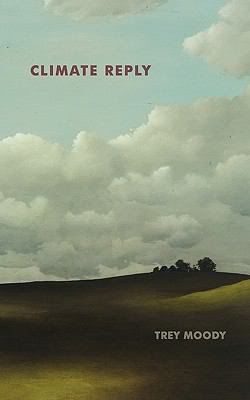
Poet Q & A: Trey Moody on Climate Reply

Moody, Trey. Climate Reply. Tuscon, AZ: New Michigan Press, 2010.

I've asked the authors of each collection we will read this semester to answer a few general questions about their books in an effort to introduce us to their writing. Our first book, Climate Reply, was written by Trey Moody who, in addition to this collection, is the author of the forthcoming Once Was a Weather (Greying Ghost Press). His poetry has appeared in Best New Poets 2009, Boston Review, Colorado Review, Denver Quarterly, and Washington Square; his fiction is forthcoming in Sonora Review. He lives in Lincoln, Nebraska, where he co-curates The Clean Part Reading Series.

1) Tell us about when you first became interested in poetry. Who were your first poetic influences? When did you begin writing poetry? What do you think poetry does or can do for us today and does this differ from your earliest conceptions of what poetry is/does? etc.

I was in college, about 20, in my first creative writing workshop when I realized I enjoyed writing poetry—at that time much more than fiction or nonfiction. That year I remember being introduced to T. S. Eliot (particularly “The Love Song of J. Alfred Prufrock” and “The Waste Land”) and Ezra Pound (“In a Station of the Metro”), which were very different from my pre-conceived notions of poetry, as I hated reading anything, including poetry, before my second year of college. Thus the love story began, and continues. Although I couldn’t have articulated this then (I got a “B” in my first workshop), what first drew me to poetry such as this was how it taxed my imagination, forcing me to feel like I had never felt—that is to say, uncomfortable, wary, unsure of everything I had convinced myself I believed in. This isn’t so much specific to poetry but rather to all art, and for me it still holds true. As Emily Dickinson remarked: “If I feel physically as if the top of my head were taken off, I know that is poetry.”

2) Give us some background on the creation, development, and gestation of Climate Reply. How does this collection differ from your previous collections or current projects? etc.

I don’t write book-length projects, which is to say I write mainly individual lyrics or shorter sequences. So Climate Reply really began to take shape after looking through some of my favorite poems I had written during MFA school and my first semester of PhD school. After messing with about six other sequences of the same manuscript for a year or two, I finally began recognizing some consistent themes in certain poems, culminating in the final version of the chapbook. So far, this process hasn’t changed in any significant way with other projects.

3) What is your favorite or most memorable poem from the collection we're reading? What about the poem, its process, or its inspiration makes it particularly remarkable for you?

My favorite poem is probably “We Use Spoons Mostly,” mostly because composing that poem—first a notebook entry, then multiple revisions on the computer—taught me many of the things I value in the poetry I’m still writing (and in the poetry I admire). Namely, letting what happens during the act of revision—literally or imaginatively—become a part of the poem.

The most memorable poem is “Climate Reply,” because it was the first time I felt like I had written a poem I would want to read. Here’s the original paragraph from which “Climate Reply” grew and took shape, in a tiny notebook of mine: “Weather as if to recite a speech. Weather as if to read a name. To ask a question, weather to ride the train, to feed the cats, to sleep. Weather to go inside, to weep.” In isolation, kind of awful, right? But like “We Use Spoons Mostly,” this poem, written years earlier, taught me more basic, yet valuable, lessons in regard to revision and the poem’s life.

4) What was the most difficult poem for you to write? Why? How did you overcome or think through these challenges?

Probably “A Feather Protruding from the Mouth.” This thing began as a prose poem, was revised and revised, then lineated, revised, revised, etc. I’m still not entirely happy with it, so I haven’t overcome any challenges, really. I like the “idea” in the poem more than I like the “experience” of the poem—to my mind, a sure recipe for a horrible poem. Hopefully the poem at least works in the context of its surrounding neighbors.

5) What, to your mind, is the overriding concern of Climate Reply? How do specific craft or poetic elements contribute to, intensify, or complicate to this concern?

In an email from a couple of years ago, your gifted teacher, Mr. Ware, put it better than I could have: “this manuscript explores the nature/culture binary and ways in which that binary crumbles when interrogated thoroughly.” The funny—and not-so-funny—thing about that email exchange is that at the time I hadn’t thought about Climate Reply in terms anywhere near as complex or well said as his. As for the second part of the question, I’d say precision—of the word, the line, the sentence, the image, everything—is the element that contributes most to this concern, for me. I want potential readers to be able to comprehend and enter the poem. I don’t want to scare them off right away. But honestly, no matter what I’m writing, I’m obsessed with precision (though, like anything, “precision” is problematic because it’s relative).

UPDATE: 09.01.11

As the previous post mentions, you will need to write a review of Trey Moody's Climate Reply for our next class session, which will be on September 12th. While you will want to address elements of craft and technique for the entire collection, I want all of you to particularly focus on individual poems. Below, I've created a list that assigns specific poems for each of you:
Miranada: "What We First Said"
Kelly: "The Listener, The Land"
Matthew Carter: "Climate Reply"
Matthew Chanlynn: "Dear, Ghosts (1 and 2)"
Kimberly: "Dear,Ghosts (3 and 4)"
Katlin: "This Forest Isn't a Room"
Samual and Alyssa: "The Book of Flattened Hands"
David: "One Question"
Taylor: "The Seating"
Jennifer: "Dear, Ghosts (5 and 6)"
Jessica: "Dear, Ghosts (7 and 8)"
Ashley: "We Didn't Believe"
Rachel: "Birdsong"
Hailey: "A Feather Protruding from the Mouth"
Lindsay: "Dear, Ghosts (9 and 10)"
Hanna: "Island of Sanity"
Luke: "We Used Spoons Mostly"
Joseph: "Remembering the Original"
Also, I want you all to come up with three questions about Trey Moody's Climate Reply, at least one of which addresses some element of poetics that we've read in Kinzie's A Poet's Guide to Poetry. While the other two can also derive from this source, you can ask more general questions about the his writing, if you wish, as well. Please, email me your question on or before Thursday, September 8th.

Finally, I'm adding an additional caveat to the composition process of your new poem for our upcoming class. Not only do I want you to write your first-draft as a 250 to 300 word prose meditation (although, if you'll remember, the revised and lineated second-draft is the version you'll be emailing to me), I want your poems to be composed in "the style of Trey Moody." Why, you may ask? As Kinzie writes, as a writer learning how to create poems, "Your goal should be to sound like others rather than create a completely original composition" (4); this need to create a poem that "sounds" like someone else's poetry derives from the fact that, especially as novice writers/poets, you need understand that a poem is not "a mere wildcat product of will, but rather a rescue, within the horizon suggested by convention, of a sequence of new turnings" (2). Or, as Kinzie states elsewhere: "Without tradition, there can be no sense of what the outer limit" (26). As such, think about the images you find within Climate Reply, as well as the line breaks, diction (i.e. word choice), and half-meanings.

29 August 2011

UPDATE: 08.29.11

Now that we've read the introduction and first section in Kinzie's A Poet's Guide to Poetry, you should have some sense of what it takes to both begin a poem and think through some of the concepts behind line breaks, etc.

At this juncture, then, I want you to focus on four specific elements while you're composing your poems. First, as I mentioned during our first class session, you should be mindful of the fact that poetry uses "language--words and sentences," to the extent that "plots and ideas are produced by and constantly dependent on language" (8). As such, I want you to focus on the language that you employ within your poems, always placing primacy upon the sounds your piece makes instead of what it actually says. This does not mean that you should ignore aspects such as "plot and idea," but they should always be subservient to the auditory capacities of your poem.

Second, as Kinzie mentions, your poem's "mental and emotional content must depend on objective counters and local embodiments" (17). Stated differently, whatever abstract feelings or ideas your poem conveys should manifest themselves, primarily, within concrete language and images. To this extent, attempt, as much as possible, to ground your reader in sensory perceptions that are highly detailed and specific. The often employed example of image-use in modern poetry, one you may have read before, is William Carlos Williams' "The Red Wheelbarrow":
so much depends
upon

a red wheel
barrow

glazed with rain
water

beside the white
chickens
This is not to say that your writing has to be as sparse as Williams' poem, but your work should, first and foremost, deal directly with images. Another well-cited example is Ezra Pound's "In a station of the Metro":
The apparition of these faces in a crowd;
Petals on a wet, black bough.
The third consideration I want you to keep at the forefront of your minds while you compose your poems during the first portion of the semester is the manner in which line breaks function within your work, specifically with relation to half-meaning. How does the "radical splitting apart of phrases create provisional meanings in the orphaned line"(59)? Moreover, remember that "An enjambed lines always creates half-meaning in addition to the 'whole' meaning of the sentence." To this extent, you'll want to develop a nuanced system of tension and release with regard to line and syntax. Take, for example, the opening to "Right of Assembly (New Mexico, 1939)" by John Chavez, the entirety of which can be found online at the Notre Dame Review. Notice tension builds, then is released as line and syntax work with and against one another:
A pointillist canvas of waving grass,
each leaf, each man is a black, brown, or damp colored

overcoat, a flannel shirt
or double breasted suit, an indifferent

skyward or trained stare. From afar the crowd
of men shift to mimic a fist of clouds,

reveal Stalin, Roosevelt or Churchill’s steadfast bust,
the apparent disassembly of women.

Of the twelve in the crowd of hundreds,
I imagine one is the mother of two soon to be killed sons,

another becoming more and more spouseless
with the passing days. Still another,
What is important to remember, of course, is that "half-meaning, which introduces such an interesting threshold of uncertainty at which we waver, depends on a solid background of lines that assert more or less whole meanings. Constant use of tension leads in time to no tension" (61). Simply put: don't over use the enjambed line; let some lines end-stop so as to keep the poem most dynamic. Kinzie later refers to this technique (not just with line breaks, but with every aspect of the poem) as "juxtaposition" (65).

And finally, as both Kinzie states in her text, and I mentioned in the previous class session: "You are moving through uncertainties," or a text that is "not yet finished, still growing" (6). In other words, if you "know" what you're going to write before you start writing, your poem will necessarily be worse off for it. Make sure that the poem, both in its construction and in its final form, offers writer and reader alike an intensely surprising, uncertain, and mysterious experience.

I would also like you to pay close attention to the way Kinzie writes about poems. When writing about Trey Moody's Climate Reply for next class period, I want you to mimic Kinzie's engagement with other poets' poems. While there are a plethora of examples that can be found within the 75 pages we've already read, check out her analysis of Robert Frost's "On a Bird Singing in Its Sleep" on pages 21-23 and Robert Lowell's "Mr. Edwards and the Spider" on pages 60-62.

HOMEWORK: For next class (09.12.11), please have the rough draft of your second poem. From here on out, the first draft of every poem you write should be as follows: draft "a preliminary 250- to 300-word creative meditation in prose" (8), then revise, edit, pare-down, and lineate your writing into a second draft. While you should keep a record of every draft, it's just the second draft you'll need to send me the night before class. Additionally, you'll need to write a single-spaced, one-page response to Trey Moody's Climate Reply. I will assign each of you a specific poem for your response. When writing this piece, make sure you are engaging the poem with concepts we've read in Kinzie, quoting both the poem and Kinzie when appropriate.