25 October 2011

UPDATE: 10.25.11

Since we did not get a chance to work-shop Kelly's poem in class yesterday, we will begin with her poem during the second-half of our next class. In addition to her poem, I will need new poems from Kim, Kaitlin, and Samual emailed to me by 10PM Thursday night so that I can get them to the rest of the class by Friday morning at the latest. Again, please make sure you write your feedback and revisions directly on the hard-copies and before class.

Furthermore, for next class session, please read Chris McCreary's Undone: A Fakebook. Afterword, please write a 1-page, single-spaced review of the collection. If any of you need a refresher on the general parameters of these reviews, you can find them in the previous Limón post.

Below is the list of poem assignments. Please focus on the poem you are assigned; toward the end of the review, if you would like to, you can expand outward and connect your particular poem to the collection at-large, drawing comparisons, resonances, and like-minded issues, etc. between them:
Miranada: "Yesterday's Song"
Kelly: "Solitary Man"
Matthew Carter: "Two-bit Manchild"
Matthew Chanlynn: "Albatross"
Kimberly: "Botched Chupacabra"
Katlin: "Disinvited"
Samual: "Ethan Frome Goes"
Alyssa: "Half-Imagined Juju"
David: "Kultured Lycans"
Taylor: "Martyrs Need Onanism"
Jennifer: "Paris"
Jessica: "Quiet"
Ashley: "Rue"
Rachel: "Screaming Trees
Hailey: "Ultraviolence"
Lindsay: "We Were X"
Hanna: "Yoda"
Luke: "Zenith"
Joseph: "Pretty Monsters"
If, by chance, there is a poem you found to overwhelmingly compelling to you, and no one else is writing on it, email me and we can schedule a switch. Obviously, there are many more poems in this collection than there are students, so this shouldn't be a problem.

Poet Q & A: Chris McCreary on Undone: A Fakebook

1) Tell us about when you first became interested in poetry. Who were your first poetic influences? When did you begin writing poetry? What do you think poetry does or can do for us today and does this differ from your earliest conceptions of what poetry is/does? etc.

I don’t recall liking much poetry in high school beyond Walt Whitman and some poems by Ralph Waldo Emerson that sat alongside his essays (which also made a significant impact on me) in our textbook. I think I had a passing interest in the Romantics, but it was more the idea of them than their actual poems. I discovered, as many have before and since, Jack Kerouac through his novel On The Road, which led me to poets like Allen Ginsberg and Michael McClure by the time I left for college. When I discovered Charles Bukowski in the middle of college, I took a detour for a few years that led to writing really narrative, cynical poems that I loved at the time – but I look back on them now and think, So what? Is that all there is? In a sense, I was being rigorous, learning to pare down my lines, but in retrospect I was relying on lazy storytelling more than anything else at that time.

As the years have gone on, I’ve stayed interested in shorter lyrics, for the most part, coming late to Emily Dickinson but making up for lost time and even preferring her to Whitman these days. Poets like George Oppen, Rae Armantrout, Norma Cole, Michael Palmer, and Robert Creeley have convinced me that every word counts. They’re almost all off-kilter & odd.

As far as what poetry can do... for me, it’s an exercise in mental exploration, both in terms of the pliability of words and sounds and in terms of what gets dredged up, psychologically, during even the most oblique approaches to writing. Grand proclamations about the role of poetry in the world have never interested me very much, but I will say that the poetry community, particularly Philly’s, has been a cornerstone of my sense of self for almost 20 years. Many of my favorite “younger” poets - and as I approach 40, I use that term increasingly loosely – live here in Philly: Frank Sherlock, Kirsten Kaschock, Jenn McCreary, too many others to list here. I’ve been reading Frank and Jenn’s work since college, and to’ve seen their work evolve over a decade and a half is extraordinary.

2) Give us some background on the creation, development, and gestation of Undone. How does this collection differ from your previous collections or current projects? etc.

Undone came about over a period of four years or so. At that point, I’d written two previous collections (The Effacements and Dismembers). My newer poems felt tighter, as they came together, and fairly early on I started to lift material from the two previous books to incorporate into new poems in an effort to “get it right” this time around, which primarily meant editing down overly wordy passages in an effort to distill them and weave them into newer work. Also, I decided on a couple of frames to block out major sections, “The Diamond Sutra” and “Fiend Folio.” Originally, the piece known as “Black Star” was much longer – maybe 20 pages – and incorporated much of what became “The Diamond Sutra.” I was stuck with it, though, feeling like the poem drifted too much and never had much at all to say. Once I conceived of the “Sutra” approach, though, much of the material fell into place. For kicks, I was knocking Neil Diamond song titles (and, at times, lyrics) up against other pop culture sources and some truly bastardized tenets of Buddhism to see what I’d come up with, and through that the Sutras as a sequence came into being. “Fiend Folio,” once I decided on the alphabetic sequence, began to take care of itself, with some of the last pieces (“Martyrs Need Onamism,” for instance) being plotted out specifically to fit the gaps in between earlier pieces such as “Albatross” and “Rue.”

3) What is your favorite or most memorable poem from the collection we're reading? What about the poem, its process, or its inspiration makes it particularly remarkable for you?

“The Black Book” was probably the most satisfying to write, so in that sense it’s my favorite. That one in particular incorporates lots of old material in a way that finally felt right. Beyond that, though, I was pleased with how I managed to sustain (I hope) the poem over so many pages, and I liked the creepy, vaguely cartoonish tone that it strikes. I particularly enjoy the disconnect between the sing-song sound of some of the passages and what’s actually being described within them, which is often quite dark. It’s a blast to read aloud, too – sometimes people laugh, and sometimes I think they’re not sure if bits of it are supposed to be funny or not...

4) What was the most difficult poem for you to write? Why? How did you overcome or think through these challenges?

“Pretty Monsters” was probably the most difficult to write. It’s the piece in the book most explicitly about my own children and the closest I think I come to sentimentality in the book. I kept coming back to the piece over the course of months, reworking and tweaking it, trying to make the narrative more disorienting and therefore, with any luck, intriguing instead of it just being a narrative about my family.

I recognize that what I’m saying has no bearing on a workshop situation at all, where writing has to be produced quite quickly, but the most important thing for me has become giving pieces time – weeks or months to sit – before I come back to finish them. I can bang up against problems in a poem repeatedly as I obsess over it, but then if I let it rest for a while, the solution is almost always obvious as soon as I sit back down to it after an extended breather.

5) What, to your mind, is the overriding concern of Undone? How do specific craft or poetic elements contribute to, intensify, or complicate to this concern?

These are really the first poems that I wrote after becoming a parent and also shifting from teaching college to teaching high school, and the presence of younger people (and generational conflict) is probably evident. “The Great American Songbook” can seem to some people like a toss-off, but it’s the most direct statement in the book, really, about aging, desire, and language itself, and they provide something of an echo chamber for much of what goes on elsewhere in the collection.

12 October 2011

UPDATE: 10.12.11

As a reminder, we do not have class on October 17th due to Fall Break. Enjoy the time off, but you will be expected to have several assignments completed for our next session on October 24th; they are as follows:

1) Read chapter 5 in Kinzie, titled "Trope and Thought," which can be found on pages 142-186.

2) Write a new poem for class. As always, first compose a 250 to 300 word prose meditation, read the assigned Kinzie, then revise your prose meditation based upon concepts covered in our reading.

3) The following students must email me their new poems by October 19th, and I will, in turn, email them to the entire class for work-shopping purposes: Miranda, Kelly, and both Matthews.

4) Everyone must provide hand-written comments (directly on a hard-copy of the student poems) for all four students. If you are one of the students providing us your poems, you must comment on the other three poems. This comments must be done before our next class and be as rigorous and critical as the comments I provided on your poems during our conferences. Please be prepared to share our thoughts about these poems in a instructive and helpful manner.

04 October 2011

UPDATE: 10.04.11

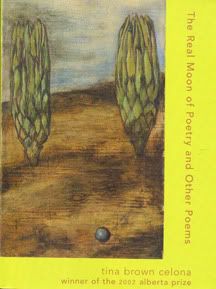
For next Monday's class session, you will need to bring a few documents with you. First, you will need to have a hard-copy of your second-draft of a new poem written "in the style of Tina Brown Celona." As such, after you write you 250 to 300 word prose meditation, ask yourself: what aesthetic, as well as thematic, concerns do I find in The Real Moon of Poetry, and how can I apply those techniques and ideas to the prose that I've written in my first-draft? Pay special attention to the manner in which she a) handles different types or styles of diction (i.e. high or low, concrete or abstract, monosyllabic or polysyllabic), b) how her use of diction alters the poems rhythm, c) how she develops half-meanings through her line breaks and d) the variable syntax of her sentences as she disperses them throughout the poem (and over a given line or stanza). Likewise, what types of images does Celona use and in what manner? In addition to the hard-copy you bring to class, make sure you email me a version by 10PM on Sunday night.

You will also need to bring a hard-copy of your review on The Real Moon of Poetry to Monday's class session. Remember, think through the poems and their relationship to the concepts we've covered in Kinzie. In order to support your claims, be sure to quote both the poem(s) from The Real Moon of Poetry and A Poet's Guide to Poetry when necessary. If you need a refresher on more specific parameters, reread the Limón post.

Below is the list of poem assignments. Please focus on the poem you are assigned; toward the end of the review, if you would like to, you can expand outward and connect your particular poem to the collection at-large, drawing comparisons, resonances, and like-minded issues, etc. between them:
Miranada: "Sentences"
Kelly: "Poet Sex"
Matthew Carter: "Fantastic Heart"
Matthew Chanlynn: "Event"
Kimberly: "Notes"
Katlin: "In My Beginning"
Samual: "The Adolescent"
Alyssa: "Dakota"
David: "Narrative"
Taylor: "A Song for the Moon"
Jennifer: "Jade Rabbit"
Jessica: "Five Difficulties"
Ashley: "Our Youth"
Rachel: "Spectacular Emotion"
Hailey: "The Office in Wartime"
Lindsay: "The Big Day"
Hanna: "Hiroshima"
Luke: "Dream"
Joseph: "Kosovo"
If, by chance, there is a poem you found to overwhelmingly compelling to you, and no one else is writing on it, email me and we can schedule a switch. Obviously, there are many more poems in this collection than there are students, so this shouldn't be a problem.

Finally, it appears that Tina Brown Celona will be with us during our next class-session, so please, compose 3 questions that specifically address craft and technique elements within the collection, referencing particular passages when applicable. Bring hard-copies to class, but make sure to email your questions by 10PM on Thursday, October 6th.

Poet Q & A: Tina Brown Celona on The Real Moon of Poetry

1) Tell us about when you first became interested in poetry. Who were your first poetic influences? When did you begin writing poetry? What do you think poetry does or can do for us today and does this differ from your earliest conceptions of what poetry is/does? etc.

It doesn’t make for a good story but I first started writing poems when I was in 9th grade. I had to write a paper on Sylvia Plath for English class.

As an undergraduate I was influenced by Russell Edson, Plath, Frank O’Hara, James Schuyler, Ezra Pound, Joseph Ceravolo, Michael Palmer, Robert Creeley, Frank Stanford, Jack Spicer, Mina Loy, Bernadette Mayer, Ted Berrigan, Keith Waldrop, and the Fluxus and Abstract Expressionist movements in art.

Later I became interested in Louis Zukofsky, Lorine Niedecker, James Tate, Nicanor Parra, Pablo Neruda, and the fiction writers Lydia Davis and David Markson.

Most recently I’ve been influenced by Edwardian fiction, Shelley, Emily Dickinson, and some younger writers, many of whom I know personally to some degree. I think a feeling of connection with a writer is necessary for influence, which is why many writers are influenced and inspired by their contemporaries: Thoreau by Emerson, Fitzgerald by Hemingway, Shelley by Keats, and vice-versa. But it’s possible to feel similarly connected to a poet who has been dead for 200 years just by reading his poems.

2) Give us some background on the creation, development, and gestation of The Real Moon of Poetry and Other Poems. How does this collection differ from your previous collections or current projects? etc.

About 80% of The Real Moon of Poetry was written while I was working on my MFA. I had published a couple of the poems in Epoch, a literary magazine based at Cornell, and a classmate had done a chapbook for me that included what was kind of a breakthrough poem for me, but which I didn’t include in TRMOP. It was called “Not Modern But The Modern World” and it was a breathless and slightly hysterical expression of angst.

My second collection, Snip Snip!, wasn’t as successful as TRMOP because I wrote the poems over a shorter period of time, and with on the one hand a kind of overblown confidence in myself, and on the other bleak depression and insecurity. It was a very egotistical book.

Since completing the coursework for a Ph.D. I feel like I have a more solid understanding of what poetry is, and how it has changed over time. Reading Aristotle and Horace on poetry, and then Alexander Pope and Shelley and Emily Dickinson, gave me a different and fuller understanding of poets and readers of poetry, what people come to poetry for. The relationship of poetry to emotion and imagination, for instance, is something that I think I understand better now than I used to.

3) What is your favorite or most memorable poem from the collection we're reading? What about the poem, its process, or its inspiration makes it particularly remarkable for you?

A poem that stands out for me (and other people, from what they tell me) is “A Poem Without A Camel.” That was designed to be a very accessible poem that worked on the principle of metonymy and metaphor. The camel can be anything you want it to be, but for me it was something pretty specific and also general: any prohibition applied to poetry. So the person writing the poem without a camel was doing what everyone said you couldn’t do, finding out that it wasn’t impossible after all. People have told me the poem is sad. It is both exhilarating to write without a camel, and sad when one wants the camel again and can’t have it. “The Velveteen Rabbit,” a children’s story by Margery Williams about a toy bunny whose boy grows up and forgets him, probably had an influence on this poem.

4) What was the most difficult poem for you to write? Why? How did you overcome or think through these challenges?

For me the difficulty lies not so much in writing poems as in publishing them. So, the poem that was most difficult for me to see in print was probably “Farm” or “Fantastic Heart” or “Poet Sex” or “On Saturday” because they were so deliberately ugly and self-punishing.

To me a poem is either a success or a failure. Poems that are easy to write tend to be successes. Some poems require more preparation and study than others. Fiddling with a poem rarely makes it better. Lopping off lines, stanzas, paragraphs, sentences, and phrases often makes it worse. If you are trying too hard to write a poem, you are probably either tired or uninspired. In that case you should stop writing and do something else until you find something that inspires you, and get some rest. But don’t expect inspiration to fall into your lap. While you are waiting for it you should be filling your head with words, ideas, images, and reacting emotionally to life, and simulacra such as books and movies. Think of this as preparing the ground for a poem, so that when the seed of inspiration falls into the furrow it has an excellent chance of growing into a beautiful flower or majestic tree.

5) What, to your mind, is the overriding concern of The Real Moon of Poetry? How do specific craft or poetic elements contribute to, intensify, or complicate to this concern?

The Real Moon of Poetry is about loving poetry while simultaneously being tormented by one’s desire and need for it. Ugliness and beauty, love and longing, fear and contempt. The white moon of poetry and the black crow that pecks at your entrails. Even more than “what is poetry?” the poems ask “is this poetry?”

I think that the poems are pretty forthright in the way they address these polarities, and metaphysical or existential problems are solved by application to real or imaginary-world situations. Feelings are invested in things and the things (or, more precisely, the words for them) in turn produce feelings. Images or symbols you might call them instead of things, but to me it makes more sense to think of words as objects in the poem’s field. The imagination is affected by things, or images of things, abstractions don’t awaken it. Poetry is different from other types of human inquiry because its form is self-evidently necessary, so that it can never be superseded or transcended by content (its body can never be left behind or forgotten).